


What Are Smart Glasses? A Buyer & OEM Guide to Wearable Eyewear Tech
Smart glasses merge compact computing hardware with regular eyeglass frames, delivering hands-on digital capabilities without forcing users to hold a phone or tablet. Unlike traditional gadgets, they are built for continuous, all-day wear: audio playback, voice control, first-person recording, real-time text overlays and sensor tracking all sit neatly inside a lightweight frame.
What separates standard eyeglasses from true smart glasses comes down to its embedded electronic architecture. Every model is built on a similar set of core components, though feature packages vary widely by product tier and use case.
- Wireless connectivity: Most rely on Bluetooth pairing with a smartphone; premium designs add onboard Wi‑Fi for standalone cloud access.
- Input modules: Built-in microphones, frame touch sensors, physical shortcut buttons, cameras and inertial motion trackers collect voice commands and movement data.
- Output systems: Frame-mounted open-ear speakers are the most common output, while higher-end variants integrate optical waveguide displays to overlay content directly into the wearer’s line of sight.
It is equally important to clarify what does not qualify as smart glasses, to avoid common marketplace confusion:
- Prescription eyewear with zero embedded electronics
- Blue-light blocking lenses marketed under vague “smart” branding (this is only an optical coating, not a computing system)
- Full-size MR/VR headsets. While these also pack displays, cameras and sensors, their bulk and use case set them apart from everyday wearable glasses.
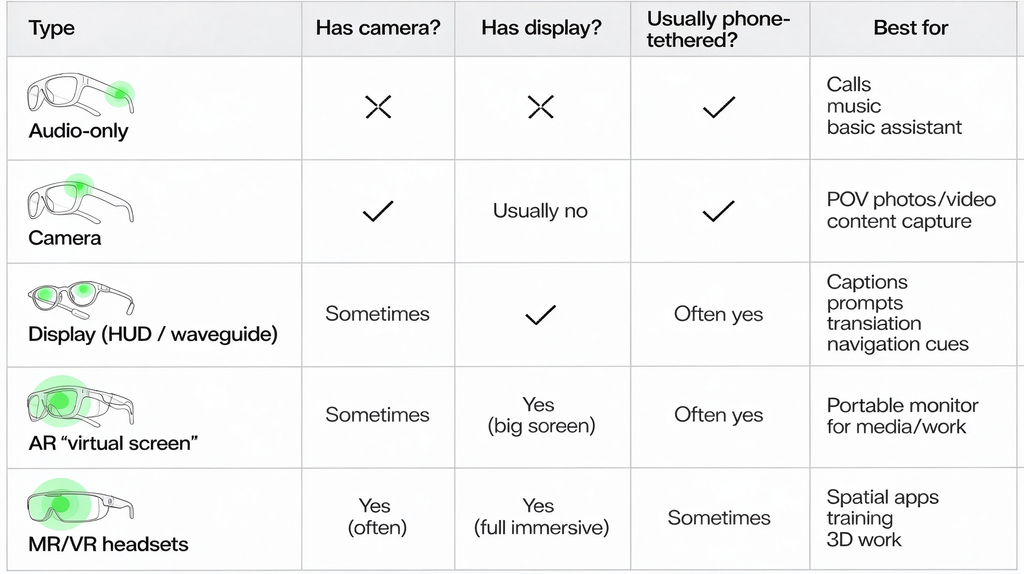
1. Audio-First Smart Glasses
Often described as open-ear audio built into eyeglass frames, this is today’s highest-volume smart glasses category. These models prioritize comfortable, casual wear and voice interaction rather than visual displays.
Core capabilities:
- Hands-free phone calls and background music streaming
- Wake-word voice assistant control
- Simple touch or button controls embedded into the temple arms
Points for product selection & customisation: Open-ear speaker designs naturally leak audio in quiet environments, which is a known trade-off. Bass performance also tends to be more restrained compared with sealed in-ear TWS earbuds. This category is the easiest to customise for private-label projects.
2. POV Camera Smart Glasses
Camera-centric smart glasses are engineered around first-person video and photo capture. The whole value proposition is hands-free recording for field work, content creation and documentation.
Core capabilities:
- Instant photo capture and continuous video recording
- Integrated microphones for synchronized audio
- Optional AI assistant and voice tagging features
Points for product selection & customisation: Privacy is the biggest consideration for this product line. A camera mounted on eyewear creates social and regulatory sensitivity. Any brand selling these must clearly include visible recording indicators and follow local recording laws for target markets.
3. HUD Display Smart Glasses (Waveguide Overlay)
Display-enabled smart glasses use transparent waveguide optics to project lightweight text and UI information over the user’s natural view, without fully blocking sight of the real world. Waveguide technology guides projected light through specially engineered lens layers to reach the eye.
Common use cases:
- Live speech transcription and real-time captions
- Turn-by-turn navigation prompts
- On-screen teleprompter text
- In-line AI translation overlays (feature-dependent by firmware)
For sourcing teams, key specs to compare are brightness, whether the unit uses monocular or binocular display layout, and outdoor readability. Some privacy-focused display models skip cameras and speakers entirely, built purely for productivity and information viewing while preserving a classic eyewear silhouette.
4. Portable AR Screen Glasses
This category acts like a lightweight, wearable external monitor. They are widely used for media consumption and extended desktop workspace, turning any location into a large virtual screen.
Common use cases:
- Streaming movies and video content
- Extended workspace for laptops and mobile devices
Points for product selection & customisation: Most of these are not designed for constant walking with live overlays active. Ergonomics, cable requirements and adapter compatibility usually become the deciding factors for buyers.
5. MR / VR Headsets (Frequently Mixed Up With Smart Glasses)
Many online resources lump MR and VR headsets together with smart glasses because they share cameras, displays and onboard sensors. But for purchasing, product planning and OEM development, they belong to a separate category.
If your target is an everyday wearable that users can comfortably put on and remove like regular glasses, you are shopping within the four categories above. If the priority is immersive spatial computing, 3D environment interaction and full virtual reality, you are evaluating headsets instead.